



Five Criteria. Three Paths. One Clear Conclusion.
Most businesses don’t start by asking whether they should build, buy, or architect their content commerce setup. Usually, it starts with a simpler problem.
A team needs livestream capabilities. Marketing teams want better engagement tools, commerce teams want faster campaign execution, regional teams need flexibility and custom localized features.
So new tools get added. Another integration gets connected. Another platform enters the stack. Over time, what looked manageable becomes fragmented.
Customer data sits across different systems. Teams rely on manual workflows. Experiences feel disconnected across channels. And scaling becomes slower than expected.
That’s when the bigger question appears: “What kind of infrastructure actually makes sense for modern content commerce?”
For most businesses, the decision comes down to three paths:
- Build everything internally
- Buy packaged platforms
- Architect a flexible ecosystem around the business
Each approach has advantages. But each also comes with tradeoffs that become more obvious as the business grows.
Here’s a closer look at how they compare.
The Three Approaches
1. Build
Building means developing your own infrastructure internally. This gives businesses full ownership over workflows, integrations, and product direction.
For organizations with large engineering resources and highly specific operational requirements, that level of control can be attractive.
However, building also requires significant time and investment before value can be realized. Depending on the scope and complexity, development can take months (or even years) before the solution is fully operational.
Beyond the initial build, internal teams are responsible for maintaining infrastructure, managing updates, handling integrations, ensuring security, and continuously improving the platform over time.
As the ecosystem grows, so does the operational burden, making it increasingly difficult to balance innovation with ongoing maintenance.
2. Buy
Buying usually means adopting ready-made SaaS platforms or packaged commerce tools. This is often the fastest way to launch.
Businesses can deploy quickly, reduce development work, and operate within existing templates and workflows. The challenge comes later.
As businesses expand into more channels, markets, and customer touchpoints, many packaged systems become harder to adapt.
Teams often end up adding workarounds, purchasing additional tools, or bringing in new vendors to fill operational gaps that weren’t apparent at the start.
While each addition may seem manageable on its own, the combined costs of licenses, integrations, maintenance, and vendor management can quickly exceed the original budget, making the overall solution far more expensive than initially anticipated.
3. Architect
Architecting takes a different approach. Instead of relying on one system to handle everything, businesses create a connected ecosystem where different tools and capabilities work together from the start.
The focus is less about replacing everything and more about creating flexibility.
That might include:
- Connecting content and commerce systems
- Integrating customer data across channels
- Supporting interactive experiences across owned and external platforms
- Using APIs to adapt workflows over time
This approach gives businesses room to evolve without constantly rebuilding infrastructure.
Five Criteria That Matter
1. Speed to Market
Build
Building internally takes time. Even relatively simple implementations require planning, development, testing, deployment, and maintenance. For businesses moving in fast-changing markets, long development cycles can slow momentum.
Buy
Buying is usually the fastest option in the beginning. Most SaaS platforms are designed for quick onboarding and standardized deployment. The downside is that businesses often need to operate within predefined limitations.
Architect
Architected ecosystems allow businesses to launch capabilities gradually. Instead of rebuilding everything at once, teams can connect systems incrementally while keeping operations flexible. That balance between speed and adaptability becomes valuable over time.
Most balanced approach: Architect
2. Flexibility
Build
Custom systems offer flexibility on paper. But flexibility depends on whether internal teams can continuously support and improve the system. Over time, technical debt and maintenance requirements can slow innovation.
Buy
Packaged platforms work well for standardized workflows. But many businesses eventually run into limitations when expanding into:
- Multi-market operations
- Interactive customer experiences
- Creator partnerships
- Retail media campaigns
- Omnichannel engagement
At that point, teams often start adapting the business around the software instead of the other way around.
Architect
Architected ecosystems are designed around interoperability. Businesses can connect specialized tools together instead of depending entirely on one platform. That makes it easier to adjust workflows, launch new experiences, and scale across different channels.
Most adaptable approach: Architect
3. Long-Term Cost
Build
Building internally often looks attractive from an ownership perspective. But the actual cost extends beyond development. There’s infrastructure maintenance, engineering resources, security management, integrations, optimization, and ongoing support. These costs tend to grow alongside complexity.
Buy
Buying lowers upfront investment. But over time, businesses often accumulate multiple subscriptions, overlapping tools, and additional integration costs. What starts simple can become expensive and inefficient later.
Architect
Architected ecosystems focus on using the right tools together without rebuilding everything from scratch. They are carefully planned at the start of the project to ensure compatibility and seamless data flow. That usually creates a more sustainable balance between operational efficiency and flexibility.
Most sustainable approach: Architect
4. Data Ownership & Visibility
Build
Custom infrastructure gives businesses greater control over customer data. But maintaining scalable and reliable data architecture internally requires significant resources.
Buy
Many packaged platforms create fragmented visibility. Customer insights often remain separated across different systems, making it harder to understand the full customer journey. That limits personalization, attribution, and audience ownership.
Architect
Architected ecosystems allow businesses to unify customer intelligence across multiple touchpoints. As customer journeys become increasingly distributed, that visibility becomes more important. Especially as businesses place greater focus on first-party data and long-term audience relationships.
Strongest long-term advantage: Architect
5. Future Readiness
Build
Custom-built systems can evolve over time. But keeping pace with changing technology and customer behavior requires continuous investment.
Buy
Packaged platforms evolve according to vendor priorities. That means businesses may eventually face:
- Feature limitations
- Restricted integrations
- Pricing changes
- Roadmaps they cannot control
Architect
Architected ecosystems are designed to adapt. Businesses can integrate new technologies, channels, and engagement formats without replacing their entire infrastructure. That flexibility matters more as:
- AI-powered experiences continue growing
- Commerce journeys become more fragmented
- Customer expectations evolve faster
- Interactive experiences become standard
Most future-ready approach: Architect
Why More Businesses Are Moving Toward Ecosystems
For a long time, businesses searched for a single platform that could handle everything. But modern commerce doesn’t really work that way anymore.
Customer journeys now move across multiple channels, platforms, and formats. Discovery happens through content. Trust builds through engagement. Conversion happens across connected experiences.
No single tool can fully support every part of that journey. That’s why more businesses are shifting away from platform-first thinking and focusing instead on building connected ecosystems that can evolve over time.
Where BeLive Fits In
At BeLive, we believe businesses need infrastructure that can adapt alongside changing customer behavior.
Not another rigid system that forces teams into fixed workflows. Our approach focuses on helping businesses:
- Connect content, engagement, and commerce experiences
- Support interactive customer journeys across channels
- Integrate with existing systems and workflows
- Scale operations without rebuilding infrastructure
- Stay flexible as digital commerce continues evolving
Because content commerce is no longer just about selling products online. We have to create connected experiences that customers actually want to engage with.
Final Thoughts
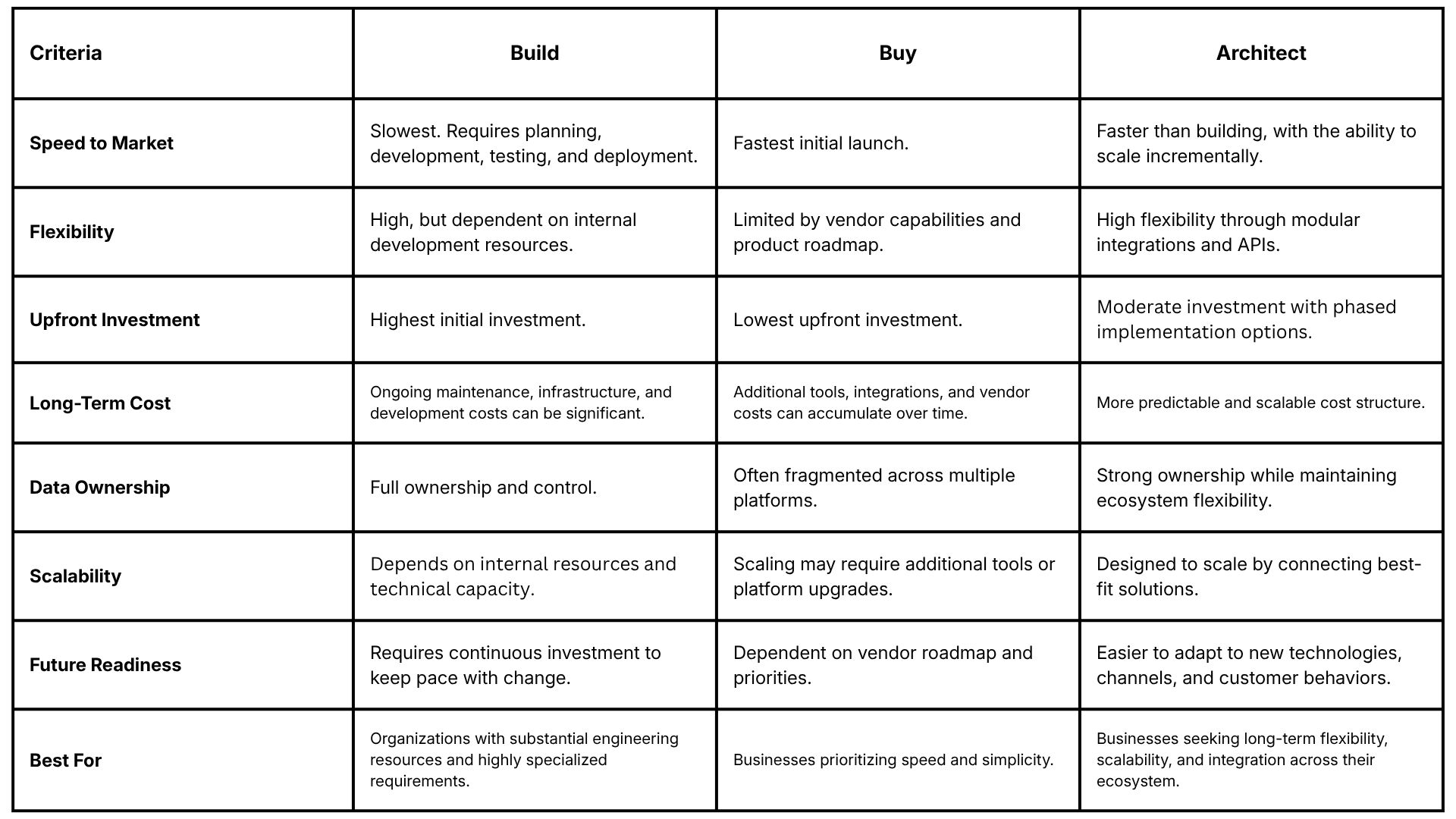
The Build vs. Buy conversation is still relevant. But for many businesses today, the more important question is whether their infrastructure can evolve with the business itself.
- Build offers control, but often requires heavy internal resources.
- Buy offers speed, but can create limitations over time.
- Architect offers flexibility without forcing businesses to start from scratch.
As content, commerce, and customer engagement become more interconnected, adaptability is becoming one of the most important operational advantages a business can have. The businesses that scale successfully won’t necessarily be the ones with the biggest platforms. They’ll be the ones with systems flexible enough to keep evolving.


